



The short answer: In 2026, the hydraulic pump market is being reshaped by two interlocking forces. Industrial electrification is replacing throttled fixed-displacement circuits with electric-motor-driven variable-speed pump systems, and servo vane pump retrofits are giving existing installations the same efficiency gains without scrapping working assets. Together they are the dominant pump-side trends in continuous-duty plants, and they are the reason we have rebuilt our vane pump engineering roadmap around low-rpm continuous-duty operation.
In our 18 years of hydraulic system integration work at NVICKS — across more than 15,000 installed pumps in 40+ countries — I have seen exactly one wave that materially changed how plant engineers specify pumps: the current electrification + servo retrofit cycle. This article explains what is driving it, what it costs, where it fails, and how to engineer a retrofit that actually pays back.

What Is Actually Driving the 2026 Hydraulic Pump Market?
The 2026 pump market is not being reshaped by a single technology breakthrough. It is being reshaped by three pressures converging at the same time, and engineers who treat any one of them in isolation tend to overspend on a retrofit or under-spec the new system.
Driver 1: Industrial electrification policies and grid decarbonization
Industrial electrification has moved from a planning topic to a procurement constraint. According to the International Energy Agency's Electricity 2024 analysis, electricity's share of final energy consumption in industry has been rising year over year as grid carbon intensity falls. For pump buyers this matters because electricity-driven hydraulic systems — even diesel-class continuous-duty machines — can now be plugged into a progressively cleaner grid, while direct-combustion prime movers cannot.
The practical consequence is that procurement teams in 2026 are increasingly penalized for specifying new diesel prime movers or constant-speed electric drives on throttled circuits. The pump, not the motor, becomes the design lever.
Driver 2: Throttling losses dominate the energy balance
The second driver is the realization that the pump itself has been the dominant energy sink. On a conventional press or injection-molding machine, the pump runs at fixed displacement and full speed. Pressure is set by a proportional valve or relief valve that throttes the excess flow across the load. That throttled flow becomes heat, which the chiller then removes.
Across our 2024-2026 retrofit audits, the typical finding is consistent: pump-stage electrical draw accounts for the majority of total machine energy, and 50-70% of that draw is throttled, not used. Variable-speed pump systems eliminate the throttled portion by reducing pump speed at low flow demand.
Driver 3: Servo vane pump technology has caught up to the application
Third, the pump technology itself has caught up. Until roughly 2018, variable-speed-driven vane pumps had a reputation for poor low-speed volumetric efficiency because the vanes would not follow the cam ring reliably below 600 r/min. The current generation of VSD-engineered vane pumps — including the T7-E variable-speed platform — uses pressure-balanced vane geometry and low-friction cartridge kits to maintain stable displacement at continuous low-rpm operation.
That engineering change is what made servo pump retrofits practical for 24/7 production lines rather than just demonstration projects.
What Is a Servo Vane Pump Retrofit, Exactly?
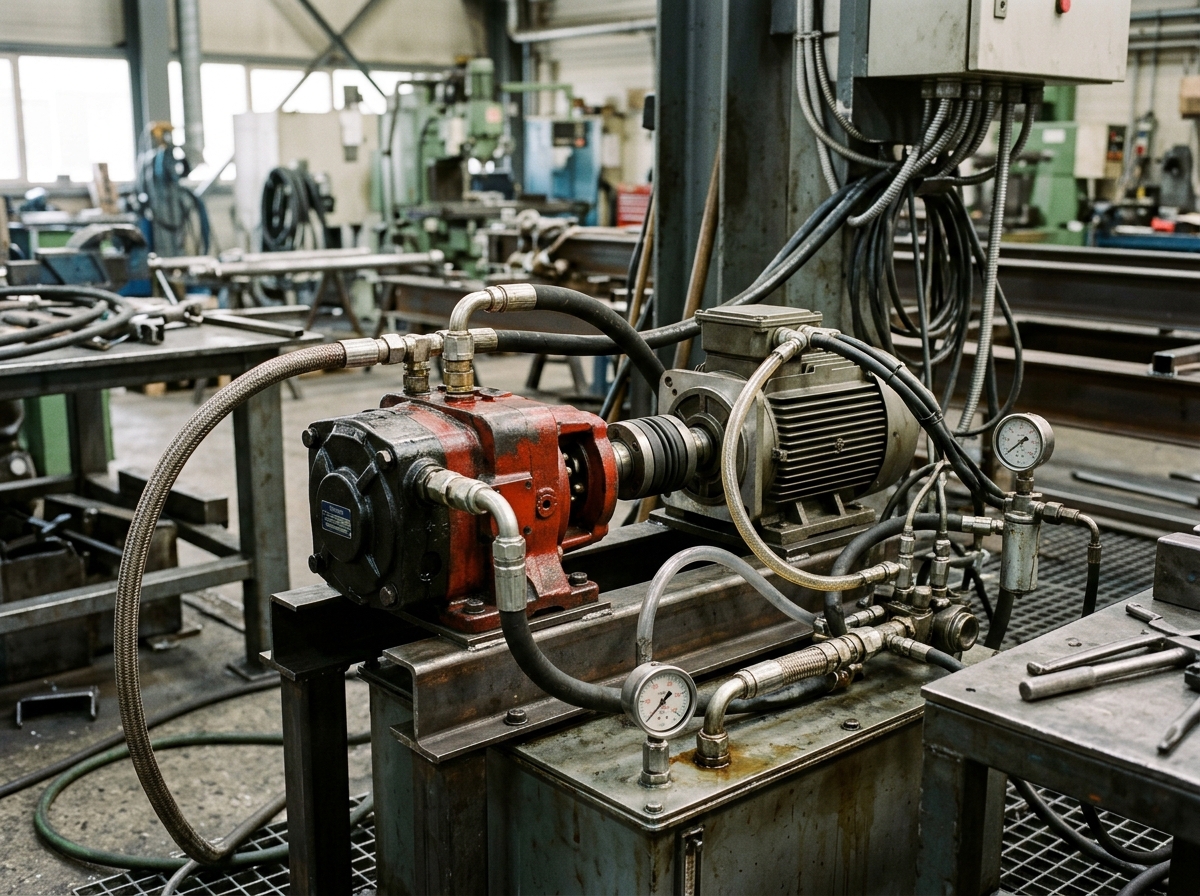
A servo pump retrofit is not a pump swap. It is a coordinated change to four subsystems: the pump, the drive, the control logic, and the hydraulic cleanliness regime. Skipping any one of them turns a payback into a maintenance burden.
- Pump replacement. A fixed-displacement pump is replaced with a variable-displacement vane pump (or, for higher-pressure circuits, an axial piston pump) engineered for VSD service. The pump must be rated for continuous low-rpm operation, not just low-rpm starting.
- Drive replacement. The across-the-line motor starter is replaced with a variable-frequency drive sized for the pump's torque curve across its operating speed range. A pump that draws 100% torque at zero flow is a common specification error; a VSD-engineered pump typically draws less than 30% torque at zero flow.
- Control logic update. The PLC or motion controller receives a new pump-speed command signal. Pressure-feedback loops close around pump speed instead of proportional valve opening. Most retrofits we engineer require <50 lines of ladder logic changes.
- Oil cleanliness upgrade. VSD-engineered vane pumps are more sensitive to contamination than fixed-displacement pumps because the same vanes that handle low-rpm operation also depend on clean hydraulic fluid to maintain the film between vane tip and cam ring. ISO 4406 18/16/13 (NAS 1638 Class 7) is the minimum we recommend.
Engineering rule of thumb
If a supplier quotes you a servo pump retrofit price that is "just the pump and drive," assume they are skipping the control and cleanliness work. Those two line items are where most retrofits fail in service.
How Much Energy and Money Does a Servo Retrofit Actually Save?
Energy savings in the field consistently fall in the 40-65% range across injection-molding, metal stamping, and press-shop retrofits. The exact number depends on three variables that must be measured before the project is scoped, not estimated.
Variable 1: The existing load profile
A press that holds pressure for 60% of every cycle and ramps for the remaining 40% will save more than a press that is in continuous motion. We typically log at least two production shifts of power-analyzer data before quoting a retrofit. If a vendor quotes savings based on assumed duty cycle alone, ask for the measurement methodology.
Variable 2: The electricity tariff
The dollar value of the savings is the kilowatt-hours saved multiplied by the local kWh rate. Because per-region rates vary, we do not state specific dollar figures in retrofit quotes — we state energy savings in kWh and let the customer apply their own tariff. This is also why the user's facility-side energy team must be involved in the project from day one.
Variable 3: The machine's operating hours
Annual operating hours is the multiplier that turns a percentage saving into a payback. Three-shift continuous-duty machines consistently deliver the fastest payback. One-shift machines often do not pay back at all because the saved energy over the operating hours is too small relative to the retrofit cost.
Representative payback ranges
| Duty profile | Annual operating hours | Typical payback range | Energy reduction |
|---|---|---|---|
| Three-shift continuous press or molding | ~6,000–7,500 | 9–14 months | 50–65% |
| Two-shift packaging or stamping | ~3,500–4,500 | 14–24 months | 40–55% |
| One-shift machine tool | ~1,800–2,400 | Marginal or none | 20–35% |
Why ISO 4413 and ISO 4391 Matter More Than Pump Brand
Engineers consistently over-rotate on pump selection and under-rotate on the standards that govern the surrounding system. Two ISO standards define the engineering envelope for any 2026 pump retrofit:
- ISO 4413: Hydraulic fluid power — General rules and safety requirements for systems and components. This is the baseline expectation for any industrial hydraulic system. It covers pressure relief, energy isolation, and the design intent behind the safety-related control functions that a retrofit must preserve. ISO 4413 is published by ISO/TC 131 — Fluid power systems and is harmonized under the EU Machinery Directive 2006/42/EC for CE-marked machinery.
- ISO 4391: Hydraulic fluid power — Pumps, motors and integral transmissions — Performance test methods for steady-state conditions. This is the standard against which published performance curves are generated. Any vendor who cannot supply ISO 4391 test data for the specific pump they are quoting is, in our view, not qualified to supply a continuous-duty VSD-pump pair.
- ISO 4406: Hydraulic fluid power — Fluids — Method for coding the level of contamination by solid particles. This is the cleanliness standard that decides whether a VSD-engineered vane pump will meet its published life target. ISO 4406 18/16/13 (equivalent to NAS 1638 Class 7) is the minimum we recommend for continuous-duty VSD-pump applications.
North American OEMs will additionally reference ANSI/NFPA T2.6.1 for hydraulic pump performance testing, which is the regional equivalent of ISO 4391.
Procurement warning
Do not accept a vendor's catalog curves as a substitute for ISO 4391 steady-state test data. Catalog curves are typically generated at 50°C with ISO VG 32 oil and may not match the actual installed conditions. A 5% efficiency shift at the operating point is the difference between a 12-month payback and a 24-month payback.
Where Servo Pump Retrofits Fail in the Field
Across 15,000+ pump installations and more than 2,000 field troubleshooting calls, the same failure patterns repeat. I want to share them honestly because the patterns are predictable and avoidable.
Failure mode 1: Vane pump run below minimum continuous speed
The most common failure mode is operating a VSD-engineered vane pump below its minimum continuous speed for sustained periods. Below that threshold, the vane tip cannot maintain hydrodynamic lift and metal-on-metal contact accelerates wear. The retrofit shows signs of failure within 6-12 months. The fix is to set the VSD lower-speed limit to the pump manufacturer's published minimum continuous speed, not to the pump's minimum starting speed. These are not the same number.
Failure mode 2: Reservoir thermal capacity undersized
A fixed-displacement pump on a throttled circuit dumps throttling losses as heat into the oil, where the heat is removed by the chiller through the oil cooler. A servo pump reduces that heat, which is the point of the retrofit. But the reservoir itself still must be sized for the residual heat load, including pump inefficiency and actuator leakage. If the reservoir was sized tightly for the original machine, it can run hotter after the retrofit because the chiller was previously removing throttling heat. Always verify post-retrofit steady-state oil temperature under full production load.
Failure mode 3: Proportional valve left in place as a parallel path
Several retrofits I have reviewed kept the original proportional valve in the circuit as a "backup" pressure control. The pump then fights the proportional valve for flow control and the savings vanish. A servo retrofit requires the proportional valve to be either removed or held fully open, with pressure control closed around the pump.
How Our R&D Roadmap Aligns With the 2026 Pump Market
The reason we have invested in the T7-E variable-speed platform and the ABT servo vane pump line is precisely because of the failure modes above. Our internal roadmap, which I oversee at our Ningbo facility, has converged on three engineering bets for 2026 and 2027.
- Bet 1: VSD-engineered vane pumps as a first-class product category. Not a fixed-displacement pump with a VSD added, but a pump whose internal geometry, vane material, and bearing selection are specified for low-rpm continuous duty. The T7-E platform is our reference design here.
- Bet 2: Pre-engineered retrofit kits for the most common machine types. Press, injection-molding, and metal-stamping retrofits repeat the same engineering pattern. We are standardizing the pump-drive-control kit for these three classes so the customer is not paying for bespoke integration.
- Bet 3: ISO 4391 test data published per pump per operating point. Our published curves now include the actual steady-state efficiency at the operating point the customer specifies, not just at the catalog sweet spot.
If you want to read the engineering rationale behind our vane pump line in more detail, our R&D roadmap is public. I would rather lose a quote to a competitor who quotes a cheaper retrofit than win a quote and watch the customer lose the savings to a failure mode we could have predicted together.
Which Path Should Your Plant Take in 2026?
Three paths are available to a plant engineer in 2026, and each is appropriate for a specific operating context. The wrong choice is the one made without measuring the existing load profile first.
Path A: Full servo vane pump retrofit
Choose this when: the machine runs more than 12 hours per day, the existing pump is a fixed-displacement vane or axial piston pump, and the existing power analyzer data shows sustained periods at low flow with high pressure.
Expected outcome: 40-65% pump-stage energy reduction, 9-24 month payback, ROI usually positive within the warranty period of the new equipment.
Path B: VSD + existing fixed-quantity pump (load-sensing only)
Choose this when: the machine runs two shifts or less, the existing fixed-quantity pump is in good mechanical condition, and budget is constrained. This is a partial retrofit; the savings are smaller because the pump itself is not optimized for low-rpm operation, but the VSD still reduces motor no-load losses.
Expected outcome: 15-30% pump-stage energy reduction, longer payback window, useful as a transitional step toward a full Path A retrofit.
Path C: Hold and monitor
Choose this when: the machine is one-shift, near end-of-life, scheduled for replacement within 36 months, or runs a duty cycle that does not hold pressure for sustained periods. A retrofit will not pay back, and the engineering effort is better spent on the replacement specification.
Expected outcome: No energy savings, but the engineering hours are preserved for the eventual replacement, where Path A can be specified into the new machine from day one.
Practical next step
If you are evaluating a retrofit, the first engineering deliverable is a two-shift power-analyzer study with flow and pressure logging. We can support that study, or your incumbent hydraulic service partner can. Do not skip it. Every retrofit we have seen succeed started with measurement; every retrofit we have seen fail started with an estimate.
What 2027-2028 Looks Like for the Hydraulic Pump Market
The next wave we are engineering for is the convergence of electrification, servo pumps, and machine-learning-based pressure profiling. Two of these are already deployed; the third is in our 2027 roadmap.
First, electrification will continue to displace direct-combustion prime movers in stationary industrial applications. Mobile machinery is harder to electrify because of energy density, but stationary presses, pumps, and machine tools will continue to move toward grid-supplied electric drives.
Second, servo vane pumps will move from a retrofit option to a default specification on new machines. OEMs will specify VSD-engineered vane pumps into new builds rather than offering a fixed-displacement pump with a proportional valve as standard.
Third, the next efficiency frontier is not the pump itself but the control algorithm that commands pump speed. We are seeing early deployments of model-predictive control loops that anticipate pressure demand from the machine cycle and pre-position pump speed before the load arrives. This is the direction our R&D roadmap is heading, and it is one reason I am still excited about hydraulic engineering after 30 years in the field.
Frequently Asked Questions
What are the biggest hydraulic pump market trends in 2026?
The two biggest drivers in 2026 are industrial electrification (replacing throttled fixed-displacement circuits with electric-motor-driven variable-speed pump systems) and servo vane pump retrofits on existing fixed-quantity pump installations. Both target the same objective: cutting throttling losses, which historically account for the majority of hydraulic system energy waste in continuous-duty production.
How much energy can a servo vane pump retrofit save?
Field data from injection-molding and press-shop retrofits typically show 40-65% reductions in pump-stage electrical consumption, depending on duty cycle. Savings are highest on machines that previously held pressure through proportional or relief-valve throttling while the pump ran at constant full displacement. Always measure the existing power profile with a power analyzer before quoting a retrofit.
Are servo vane pumps suitable for 24/7 industrial duty?
Yes, when properly specified. Variable-speed-driven vane pumps designed for VSD service — such as the T7-E platform for variable speed drives — use low-friction cartridge kits and pressure-balanced vanes to maintain volumetric efficiency below 600 r/min. For 24/7 continuous duty, specify continuous-duty rated bearings, verify oil cleanliness to NAS 1638 Class 7 / ISO 4406 18/16/13 or better, and confirm reservoir thermal capacity.
What ISO standards govern hydraulic pump system design?
ISO 4413 covers general rules and safety requirements for hydraulic fluid power systems. ISO 4391 defines steady-state performance test methods for hydraulic pumps, motors, and integral transmissions. ISO 4414 covers hydraulic systems used in machine tools. Compliance with ISO 4413 is the baseline expectation for OEM skid builders shipping into the EU, while ANSI/NFPA T2.6.1 covers the equivalent performance testing convention in North America.
Is electrification the same as full electrohydraulic actuation (EHA)?
No. Electrification in the hydraulic pump market refers to replacing the diesel prime mover with an electric motor and adding variable-speed control, while keeping a conventional hydraulic actuator. Full EHA replaces the central hydraulic power unit and lines with self-contained electrohydrostatic actuators at each function. EHA is dominant in aerospace and small mobile platforms; industrial electrification with variable-speed pumps remains the higher-impact retrofit for existing plants in 2026.
What is the typical payback period for a servo pump retrofit?
Payback in our 2024-2026 retrofits has generally fallen between 9 and 24 months for machines running more than 12 hours per day. Three-shift continuous-duty presses typically fall in the 9-14 month range; two-shift packaging lines tend toward 14-24 months. The largest variable is electricity tariff, not equipment cost — verify the local kWh rate and the machine's annual operating hours before modeling the payback.
Does the T7-E vane pump require a specific variable-speed drive brand?
No. The T7-E variable-speed vane pump is brand-agnostic with respect to the VSD. The engineering requirements are VSD sizing for the pump's torque curve across the operating speed range, VSD lower-speed limit set to the pump manufacturer's published minimum continuous speed (not minimum starting speed), and VSD acceleration/deceleration ramps tuned to the pump's inertia. Any name-brand VSD that meets these three requirements will work.
How is hydraulic pump market electrification regulated in 2026?
There is no single global regulation. The EU Energy Efficiency Directive (recast) sets industrial energy audit obligations that indirectly drive pump retrofits. The U.S. Department of Energy's Better Plants program provides voluntary energy-reduction targets that participating manufacturers commit to. China's dual-carbon policy framework creates provincial-level mandates that vary by region. In all three jurisdictions, pump-side electrification is the single largest available energy-reduction lever for continuous-duty hydraulic machinery.
Planning a Servo Pump Retrofit?
Send us your existing pump model, drive rating, and a one-shift power-analyzer log. We will return a savings estimate and ISO 4391 test data for the proposed VSD-engineered vane pump pair within five business days.
Talk to a Hydraulic Engineer